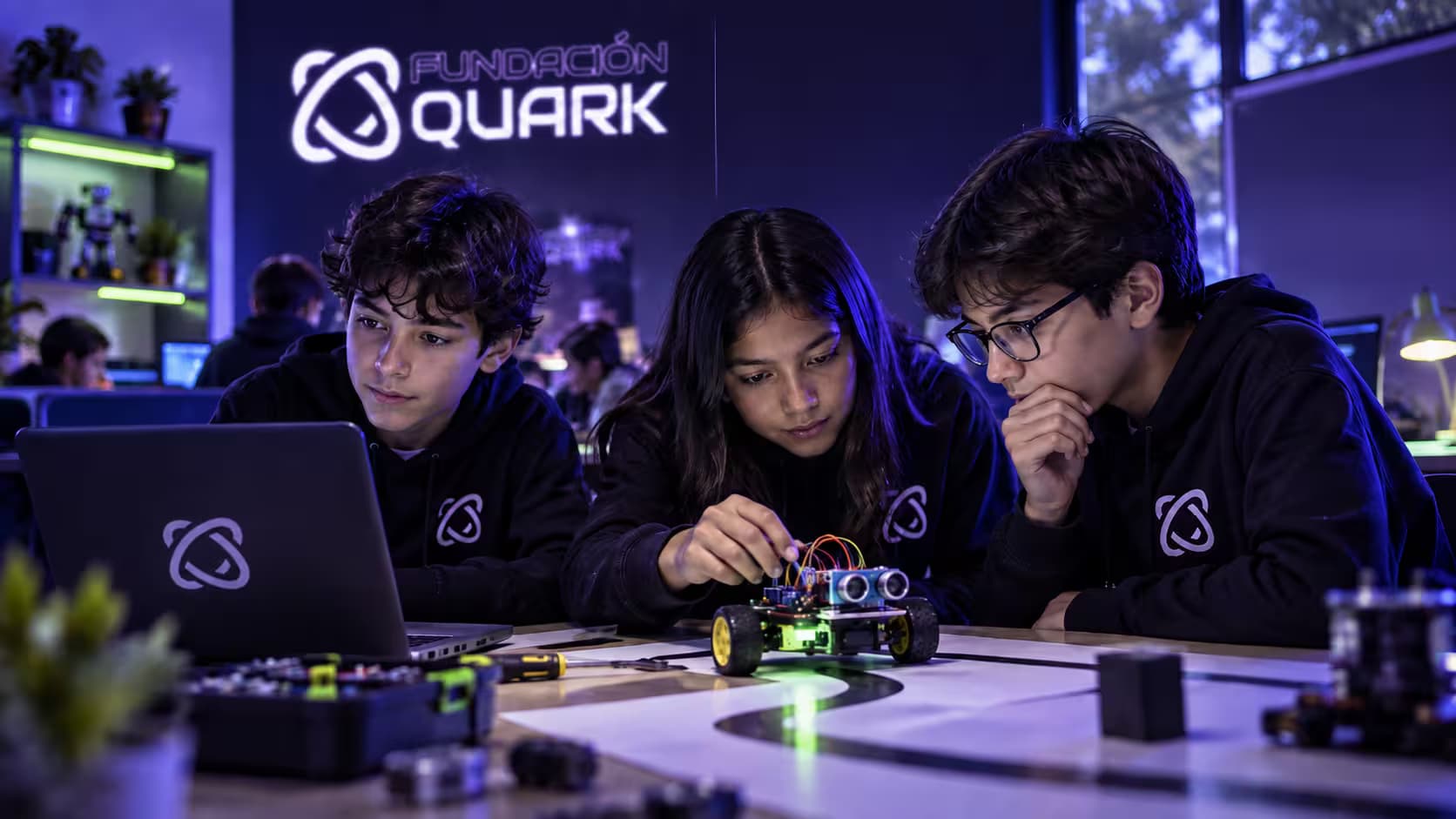
The robot is supposed to move in a straight line. Instead, it spins in place.
Something is wrong.
It could be the program, a motor, a poorly written condition, or a connection. The answer is not waiting at the end of a textbook. It is right there, moving in front of you. You have to figure it out.
Program, test, get it wrong, understand what happened, and try again. That small cycle sits at the center of Quark Robotics Lab, a Quark Lab project that Quark Foundation is preparing to bring real experiences in robotics, programming, and applied learning within reach of more students.
But our real interest is not the robot.
It is what can happen around it.
Knowing something exists is not the same as having access to it
A student today may know that programming, artificial intelligence, engineering, automation, or electronics exist. They may see them in a video, hear about them in class, or watch other people build things online.
That does not mean they have had the chance to experience them.
There is a huge difference between knowing that a sensor exists and wiring one up. Between watching a robot and programming it. Between hearing what an algorithm is and writing one to solve a problem in front of you.
For many students, especially those facing greater economic, social, territorial, or digital barriers, that distance is still real.
And that distance matters.
Not because everyone should become an engineer or a programmer, but because it is hard to imagine a path as your own when you have never had a real chance to explore it.
Quark Foundation works so that a person's circumstances do not limit their real possibility to learn, grow, and build their future. That is why one of our principles is that access should not end with handing over a tool or showing someone a piece of knowledge: we want that access to become capability, autonomy, and new possibilities for development.
Quark Robotics Lab is one concrete way to put that idea into practice.
The robot is an excuse to face real problems
Building and programming something physical has a powerful quality: it responds.
If the code is wrong, the robot does not do what you expected. If a condition is poorly designed, it makes a different decision. If a sensor gives a strange reading, you have to find out why.
The student does not receive only a grade telling them they made a mistake. They can see the result of their own decision, change it, and test again.
That creates room to learn programming, electronics, logic, or mathematics. But it also creates room for something harder to teach directly: persisting through a problem, breaking it into parts, testing a hypothesis, asking for help when needed, collaborating, and explaining why a solution works.
Research on educational robotics has found positive effects on STEM learning, problem solving, and creativity, although outcomes vary by age, context, and instructional design. That variation matters: placing a robot on a table does not automatically create learning. (Ouyang & Xu, 2024; Zhang & Zhu, 2024)
That is why we want to observe what actually happens.
Our first pilot has to learn too
The first implementation of Quark Robotics Lab is designed for 12 students between the ages of 12 and 14.
It will be a small cohort because we need to look closely: how long an activity really takes, where difficulties appear, how much help is required, which parts create the most interest, when greater autonomy starts to appear, what fails in the hardware or software, and what we should keep or change.
We do not want to design an educational experience from an office and assume it will work.
The first version will be tested, measured, and then adapted with evidence.
That principle applies to us too:
program, fail, correct.
Pilot 01 does not exist to prove that Quark already knows the best way to teach robotics. It exists to discover what we still need to learn before building a more repeatable and better-grounded version of Quark Robotics Lab.
More futures to choose from
The most important part of the project may not be visible in a robot at all.
It may appear years later.
One student may discover that they enjoy programming. Another may become interested in electronics, design, or engineering. Someone else may enjoy inventing a solution more than building it and move toward innovation or entrepreneurship. And another may discover that none of those paths are for them.
That is valuable too.
Because the goal is not to decide which path each student should follow. It is to make sure they can encounter enough paths to make that decision with more freedom.
Available evidence links positive STEM experiences, self-efficacy, and STEM identity with young people's educational and career aspirations. That relationship is not automatic: participating in a robotics experience does not determine anyone's future. (Jiang et al., 2025; Zhou & Shirazi, 2025)
But it can offer something that was not there before: a personal experience from which to imagine that future.
All of this can be summarized in one idea:
What we build and measure are capabilities. What we communicate is the horizon.
Solving problems, programming, creating, testing, collaborating, and correcting are what we can work on and observe. What we hope to expand through them is something much larger: the possibilities a student can recognize for their own life.
We do not want to tell a student what their future should be.
We want them to have more futures to choose from.